Monday, September 14, 2015

Maker Challenges

   I am developing a Maker Space in the Library this year.  I will also be co-leading a Maker Club with another teacher that will be held on alternating Fridays.  My administration has encouraged me to seek out ways to tie Maker activities to the curriculum.

   To build up interest in the Maker Space, I held a Maker Challenge last Friday in the Library during both of our lunch periods.  Since the toys for the new Star Wars Movie came out on that day, I selected  a Star Wars related challenge.  Participants were to pick a Star Wars character or ship to construct. For the challenge, I borrowed my children's Lego bricks and printed off several images of Star Wars ships and characters.

   The session was a hit!  About fifteen students in each lunch attend as well as two teachers.  The teachers and students created Darth Vader as well as a Tie Fighter, an AT-ST Walker, an Imperial Star Destroyer, two AT-AT Walkers, and a Speeder bike.

     I handed out prizes for the best ship in each lunch as well as best character created.  Into the next week, several teachers and students have stopped by the library inquiring about when the next Maker Challenge will be held.

     Another part of the success of the first Challenge was that our broadcast teacher used it as an opportunity to train one of his students in video production.  The student attended the second session of the Maker Challenge, and turned his footage into a video about the Maker Challenge.  This video gave the library Maker Space some great publicity and appeared on the all school broadcast announcements the following week.


       I look forward to holding another Maker Challenge next month.  Some buzz has been created about the Makerspace, the challenge now is to build on that and connect it with some curricular projects!

Keep up with the Golden Eagle Library on Twitter and Instagram: @GoldenEagleLMC
#ljhslmc

Follow me on Twitter: @brian_librarian


Tuesday, September 1, 2015

Diving into Maker Spaces with Both Feet

    With the opening of the new school year, I took the plunge into the world of maker spaces.  My school has a tradition of making our first back to school meeting a fun one.  Last year, we held a zombie scavenger hunt around the building with GPSs.  This past June when I met with the administration for my yearly evaluation, I proposed opening a maker space in my library workroom.  During that meeting, they encouraged me to pursue the maker space and also to consider how maker concepts could be incorporated into the curriculum and within our academic teams.

     With this challenge as a backdrop, I worked with a colleague to set up a two hour professional development session for my teachers where they would learn what the maker movement is and understand the possibilities it holds.   My assistant principal and I then surveyed our options and made plans for how we could empower teachers to create their first maker projects.

     Although my interior decorating skills are negligible, I had the idea the night before to layout maker "center pieces" on all of the tables where staff were seated.  This proved to be an effective way to show my colleagues the broad range of materials and possibilities that fit under the maker umbrella.
   
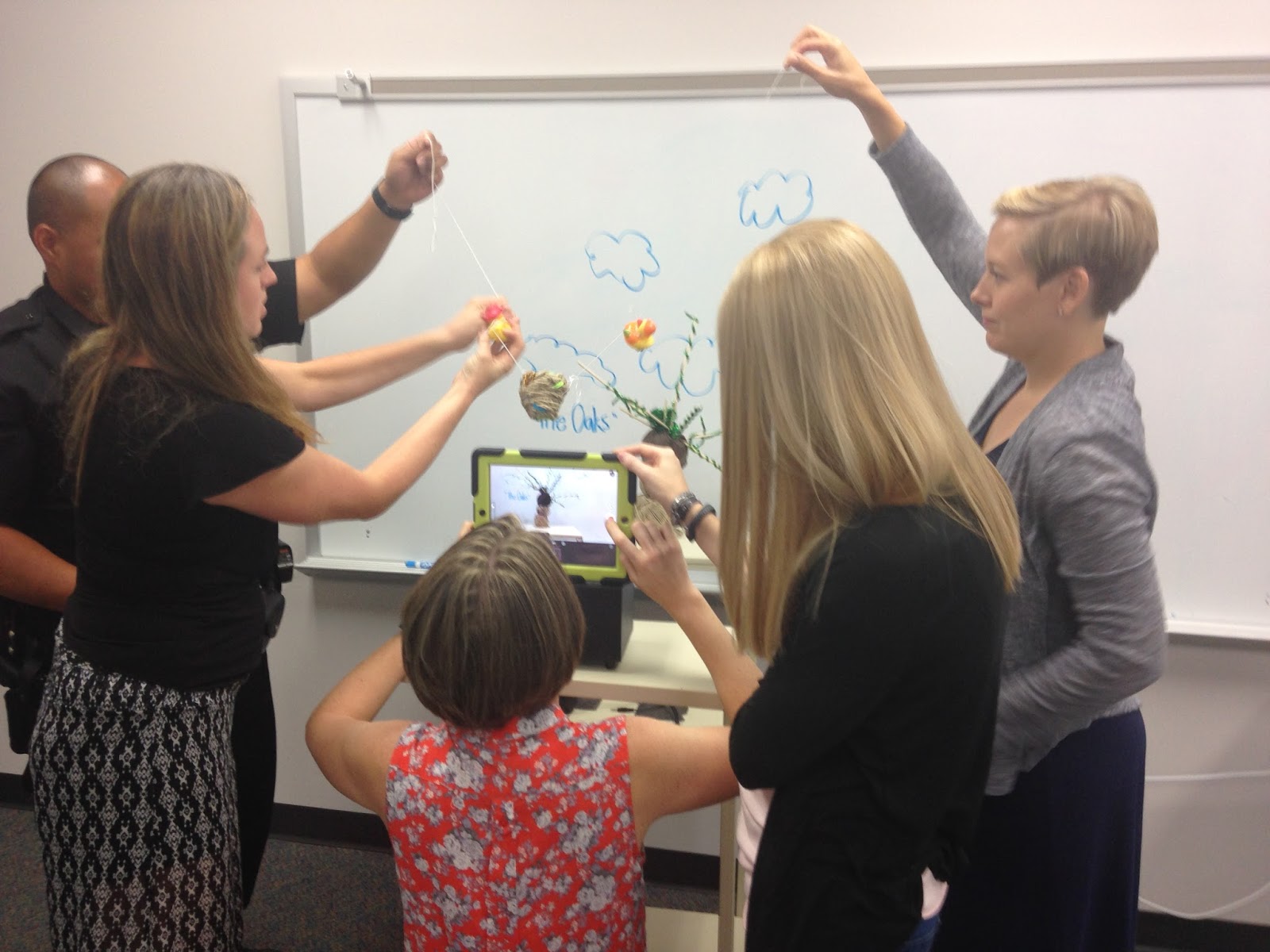
     One of the session goals was to have our academic teams create a project that was related to a goal their team had, their team name (which they were selecting at the first part of the session), or a part of the vision for their team.  Since some of the teams had not met together before, we had to plan in some extra time in the session so that they could get to know one another and collaborate towards this goal.  This ended up being one of the best part of the session and helped to set our teams up to succeed in creating some pretty impressive maker projects in a short period of time.

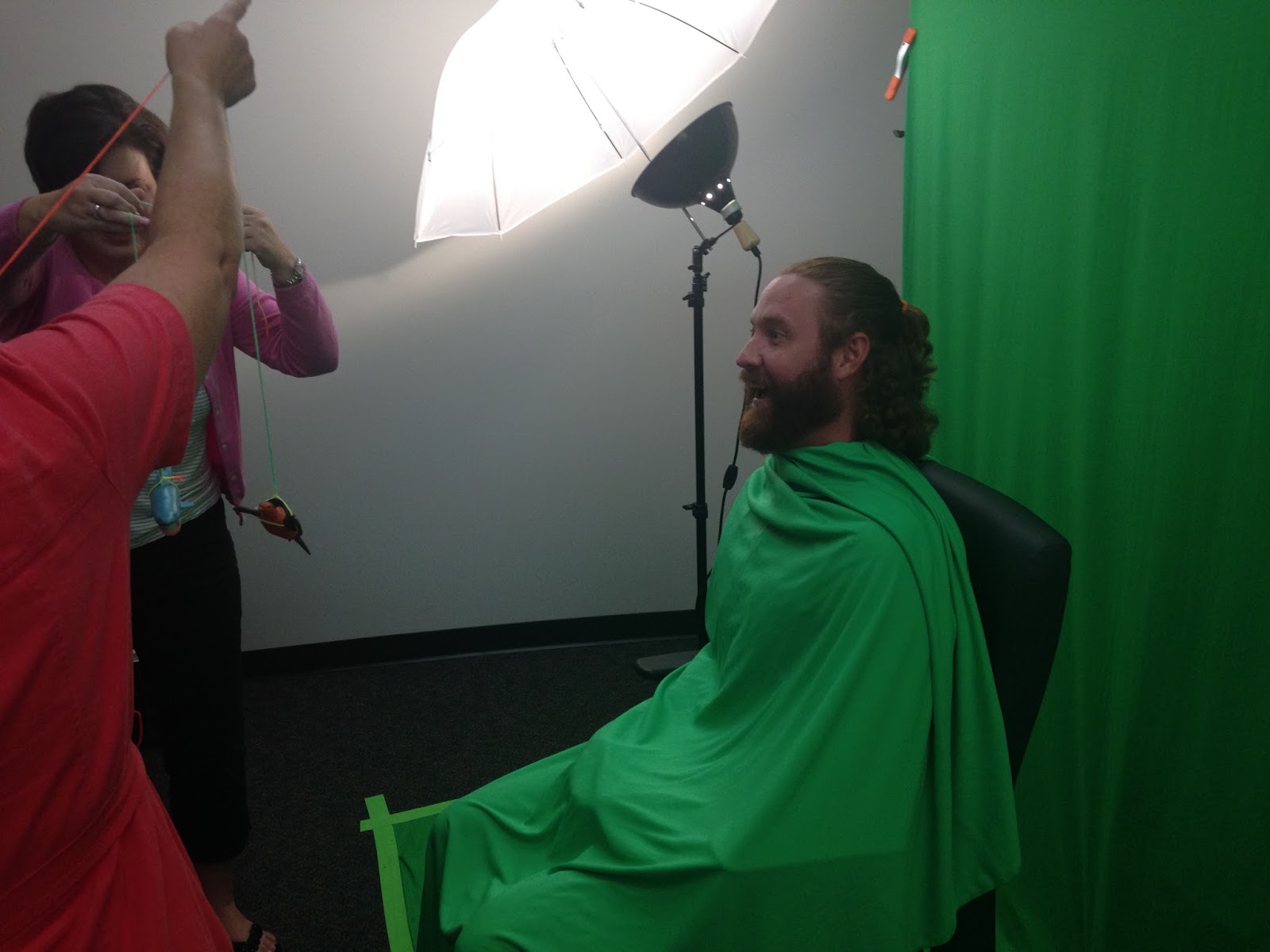
    After a short review of several of the sessions' maker project options which included duct tape projects, Legos, action figures, crafts, green screen and stop action video productions, our teachers got to work.  As in most maker projects, time was the enemy.  Nonetheless, the projects developed by the staff were impressive!  There were several videos including a stop action, and  a green screen production, as well as a presentation where an Ironman doll was repurposed as an poster advertisement for the goals of one academic team.  Our session concluded with a chance for each team to present their projects and tie in the goals and vision of their teams.

    There were several takeaways from this two hour session.  First,  as one teacher new to our staff comment that this was " the most fun" he had ever had at an opening staff meeting.  Having fun was also a catalyst for doing the work of teaming and clarified each team's vision and goals for the year.   My teachers also saw the "can do" spirit of the maker movement first hand and now see its possibilities for their students. As one teacher put it, maker projects are "so practical, (we) can do them in my classroom." (with the supplies on hand) In terms of what I would do different, I would seek to make more direct connections with teachers' content.  I had a few maker projects on hand to show teachers and briefly referred to how they might fit in with different content disciplines, but I wish there had been more time in the session to flesh this out.
   
    The challenges from here are to build on the momentum of this session as the school year begins.   Several teachers have already donated materials and connected me with community resources to obtain supplies for our maker space.  I hope to be able to blog more in the future about how I have worked with teachers and students this year to incorporate maker projects directly into their curriculum and their lives.


Monday, July 13, 2015

Is School Hard Enough?

    My wife is currently in graduate school to become an instructional facilitator.  As she has pursued her studies, we have had great conversations about instructional technology.  I have also come across several "hey honey, you really need to read this" texts from her coursework.  One of the most intriguing is a book called Mindset by Carol Dweck.

    If you are not familiar with Mindset, it is a fascinating work about how we mentally frame what we are capable of accomplishing.  Typically, people either fall into one of two categories: fixed mindset-i.e. my abilities are fixed and my life challenges can profoundly limit my capabilities, or a growth mindset: my abilities are not fixed and the sky is the limit for what I might do with those abilities.
I recently saw the growth mindset at work in this year's Google A Week Championships, or G.A.W.Cha (Gotcha).

     Two years ago I attended the Google Conference in Conway, Arkansas.  One of the ideas that was shared there was a Google A Week contest.  Since returning from that conference, I have held a Google A Week Contest for my students.In this contest, a question is posted in the library each week and on the school wide video broadcast for students to develop their research skills.  Often these questions come from current events and require students to research a question using Google, locate the correct answer and the web address where it came from, and turn in the fruits of their research on a piece of paper.    Each Friday right before I go home for the weekend, I sort through student answers and randomly select one of the students who submitted a correct response to win a chocolate bar.

     This is the second year in a row that we have hosted the Google A Week Championship (or G.A.W. Cha-Gotcha) in the library near the end of the school year.  There is an open invitation for any of the Google A Week Contest winners to come in at lunch and compete against the other winners to be the overall Google Champion at Lakeside.  Last year, I selected about 5 pretty challenging questions and about 10 students participated.

     This spring, I heard about a way to combine multiple Google Apps for Education from my colleague Brooke Higgins.  She mentioned learning about this on a technology podcast that I never did locate that had a presenter from Australia. (Sorry, Brooke :) )   I decided to try out this Multiple Google App approach for this year's Google A Week Championships.

     To accomplish this, I created a series of questions where students had to identify a landmark or location on Google Earth and then conduct further research with the Google Search engine to find the answers. I hooked up a laptop with Google Earth on it to each of the 7 screens in the library and gave the students a Chromebook with which to complete further research and submit their answers.

     This opportunity was better attended then last year as we had 13 participants.  With some help from my assistant, about 30 students were recruited to watch the Championships during both lunches.


     In a word, this year's Google A Week Championships were fascinating to watch.  They were fascinating because of the diversty of student participants.  There were students whose schedules are filled with advanced courses, average students, as well as ESOL learners and one student from the self contained special education classroom.

    Another point of fascination was the way students worked to answer the questions.  It was silent and they were all completely focused.  In fact, they were so focused, that when the bell rang for the end of lunch, no one moved!  Finally, after about 10 minutes, I told the student partcipants that they would have 5 more minutes and then I would write them a pass on to their next class.


    At one point during the contest, one of the spectators got up and asked me if he could join in because as he put it:  "it looks hard."   That's right, it was of interest to him because it looked difficult! So I gave him the opportunity to participate.

     My experiences and the feedback I got from students during G.A.W. Cha this year got me thinking about what changes we may need to make to the types of extension activities we plan for our students.  I am not advocating that as teachers we need to add extensions in the form of supplemental problems, or paragraphs-that is simply not very motivating.

     What if instead we planned more activities that were both very challenging, and motivating at the same time?  Admittedly, the questions in this year's G.A.W. Cha were hard; and maybe too difficult. (the highest overall student score was 7/10)  But inspite of that, not one student complained that it was too hard or made excuses and no one gave up.  As I mentioned before, a spectator actually asked to join up for that very reason-it looked like a difficult task, so they were motivated to try.

     The level of difficulty did not stop the students in the Championships from getting into such a flow with the activity that when the bell rang, they did not want to leave!  Instead it inspired them.
   
     What if we started with this question for developing extension/enrichment activities:  how can I inspire my students to want to learn/do more with their learning through this activity/experience?  I believe that would go a long way to fostering a growth mindset in our students, give them more, deep learning experiences with our curriculum and push their desire to become lifelong learners to the next level.

Follow me:

On Twitter: @brian_librarian
                    @GoldenEagleLMC

On Instagram: GOLDENEAGLELMC

Friday, June 26, 2015

Book Review: Death Coming Up the Hill


DCUTH.jpg Admittedly, I was intrigued by the premise of Death Coming Up the Hill before I picked it up.  After all, it is a novel in verse-haiku actually, that has the exact number of syllables of the United States’ casualties from the Vietnam War in 1968.  


I was also skeptical about whether the author could tell a full story operating within the constraints of haiku poetry.  The answer is emphatically yes: instead of limiting the power of the story, writing in such a format, Death Coming  Up the Hill’s sparse prose packs true emotional power.  


Death Coming Up the Hill tells the story of Ashe, a 17 year old junior who sees his senior classmates being drafted into the Vietnam conflict.  His history teacher opens up the bitter realities of the war to him through class discussions that ultimately help him to better understand the conflicts in his own life. This novel contrasts the Vietnam War with the ongoing battles between Ashe’s parents at home.  Their conflict stems from the family’s beginnings. Ashe’s parents had him out of wedlock during his father’s senior season of football at the University of Arizona.  His birth builds resentment in his father who believes Ashe’s birth cost him a shot at a promising football career in the NFL.  


Ashe’s parents have decided to stay together only because of their mutual love for him. Their resentment for one another is only exacerbated by her mother’s decidedly anti war stance.  Her father is a staunch supporter of the war, while her mother fills her time with antiwar rallies and protests.  


Much like the guerilla conflict across the globe in Vietnam, Ashe’s home life is full of landmines, ambushes, grenades and other wartime hazards that explode as his parents’ relationship continues to disintegrate.  When Ashe’s mother becomes pregnant with an anti war protestor’s child, it ends any possibility of a peaceful resolution to their conflict.      


Divided into chapters by the weeks of 1968, with the number of casualties each week matching the number of syllables in the chapter, Death Coming Up the Hill is a stark, poignant tale that accurately captures the tension and despair of the Vietnam period and its impact on one family.    


Death Coming up the Hill is a good fit for middle grades and above.  The subject matter is intense, but this easy to read novel in verse will resonate with reluctant readers and those interested in historical fiction and the Vietnam War time period.  

(Cover used with the permission of the author) 

Follow me on Twitter:
@brian_librarian
@GoldeneagleLMC
http://goldeneaglelibrarybookblog.blogspot.com/

Monday, May 25, 2015

Value Added Hashtags?

    This year, I have dabbled in using social media to promote the library program.  While I have set up a Lakeside Junior High School Library Twitter page (@GoldenEagleLMC), a Library Facebook account as well as a library Instagram account, I have experienced very limited success in getting my students to integrate these library accounts into their social media diet.  In fact, the number of teacher followers on this platforms has generally dwarfed the number of student followers!

   Two Fridays ago, I took a great leap forward in using social media to promote the library through hashtags.  Previously, I have participated regularly in the variety of tweet chats. (If you are not familiar with tweetchats,  the way they work is that you post out to the questions posed by the moderator with a hashtag (#arkedchat for example) at the end of each tweet- it is a great way to grow your PLN!)

   This move forward with hashtags, all started when I got an email from one of the Spanish teachers asking if she would mind if the library was included in a photo scavenger hunt she had designed for her students in honor of Cinco de Mayo.  Of course I emailed her back that I would gladly participate!

     As I read the email, it got me thinking about how I might use hashtags to promote the library through this activity.  I proposed that we add a social media component to encourage students to share the photos they took during the scavenger hunt on Twitter and Instragram with the hashtag #cincodemayoljhs.  The teacher agreed to share the hashtag with her students for this activity.

     I created a few signs around the high traffic areas of the scavenger hunt around the school that featured the hashtag #cincodemayoljhs.  While no students posted to Twitter, students did add several photos on Instagram-12 in fact, with that hashtag throughout the day.  While a dozen might not seem like a lot, it meant that in each of the 7 hours of the school day, student groups were posting photos using hashtags as a part of the library program for the first time!


     The success of using hashtags in this scavenger hunt got me thinking about how hashtags could instantaneously improve student interactions with the library.  What if I publicized upcoming library events on Instagram with a library hashtag? (#GoldenEagleLMC)  What if I used the library hashtag to promote new books/services in the library? Would this encourage previously less interested students to participate in programs increasing our student attendance at these events, or increase circulation of library materials?  A question for my fellow library/media specialists-how have you best employed hashtags to promote your libraries?  I look forward to exploring these possibilities next year!

    My experiences getting students to use hashtags reminded me of when cell phones first entered into schools.  One of my favorite quotes about this was: "students have them, so we might as well put them to good use!".  I think that phrase definitely applies here: "if students are using hashtags on Instagram, we might as well put them to good use to promote the LJHS library program!"

Follow the Golden Eagle Library:

Instagram: GOLDENEAGLELMC

Twitter: @Brian_librarian
             @GoldenEagleLMC


Sunday, May 24, 2015

Telenovellas Hangout

    My adminstrator asked the teacher leaders in a meeting the other day what was going on in our classrooms as the school year comes to a close.  I responded that as media specialist, I was working to "tiptoe around the testing schedule", and fit as much library programming in as possible for my students before the school year ends.

    One of my favorite (and unfortunately last) programming events of the 2014-15 year was our latest Lakeside Squared Hangout with students from 4 Spanish classes, 2 from Lakeside JHS Springdale where I work, and 2 from Lakeside High School in Hot Springs, Arkansas.  This Hangout was kind of a one year anniversary Hangout from when Stony Evans, media specialist at Lakeside Hot Springs, and I began the Lakeside Squared Hangouts tradition last May with a book club Hangout about Veronica Roth's popular novel Divergent.

   Not only was this the first time we had held a Squared Hangout with 4 classes at once, but it was also one with a number of other "firsts".  This Hangout was our first working with our foreign language departments, and also the first one that was conducted almost completely in a language other than English. This Squared Hangout was also our first one where students presented dramatic works they had created themselves. Student groups from both schools presented the telenovelas-short and often violent Mexican soap operas for each other through Hangout.  Students also had the opportunity to practice their Spanish skills by asking and responding to questions posed by their peers after the telenovela presentations.

   I am excited about the new ground that has been broken with this Squared Hangout.  Expanding into a new academic department, Spanish will give our students new possibilities.  Getting the Spanish department to participate gives us opportunities for ongoing Spanish language skill practice between classes/schools and has potential to be expanded to include more native Spanish speaking classes/schools from around the world to join future Hangouts through the Google Arkansas Network Group, (G.A.N.G.)


   If you are interested in having your students participate in the Google Arkansas Network Group Hangout Community, click here to sign up and join the Google Arkansas Networking Group (G.A.N.G.) today!

@Brian_librarian
@GoldenEagleLMC
@Stony1220


Wednesday, April 15, 2015

Building the G.A.N.G.

     Last month, Stony Evans, the Media Specialist at Lakeside High School in Hot Springs, Arkansas and I presented about our Lakeside Squared Google Hangout program at the Arkansas Association of Instructional Media Conference.  We also promoted our new Google + community the Google Arkansas Networking Group. (G.A.N.G.) at the conference and added about a dozen new members.

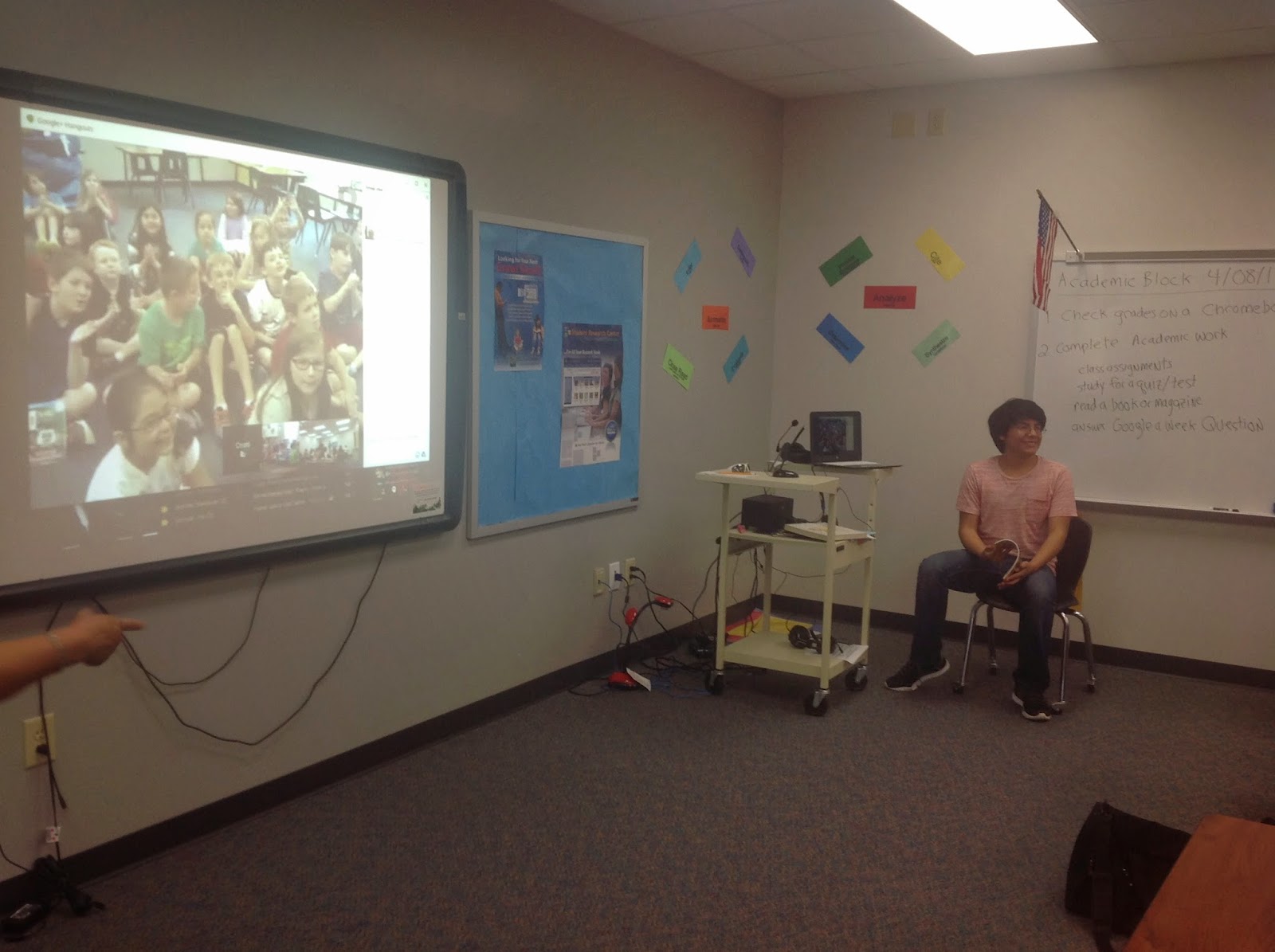
     This past Wednesday, I held our first G.A.N.G. Hangout with two of my elementary library colleagues at Young and Shaw Elementary schools in Springdale.  In celebration of School Library Month, about 20, 8th and 9th grade students from Lakeside Junior High School where I am the media specialist, met to share picture books through a Google Hangout with first grade students at the two schools.

    The event was a huge hit.  Several students read stories ranging from Dr. Seuss' The Return of the Cat in the Hat, to We're Going on a Bear Hunt, Henny Penny and Silly Sally.  The Lakeside students read with confidence and enthusiasm, adjusting their volume and pitch for the different voices in the stories.  The also managed the technology well so that each story's pictures could easily be seen by the first graders through the web cam.

    There was a high level of engagement in all three groups evidenced by the smiles, laughter and applause at the end of the storytime.  One elementary student also gleefully commented, "hey, I know that story!" Even the day after the event, Lakeside students came back to view pictures and video clips from the Virtual Storytime.  After the pictures/videos were shared, the student readers were applauded by their peers.

    There were some slight issues with volume and locating each other at the start of the Hangout, but overall it went well.  We are already in discussion about holiding our next Virtual Story time.  In honor of Poetry Month, we are looking into holding a Poetry Slam.  This type of event will promote more interactivity and two way communication between the different classes that partcipate.

    It is just a matter of setting up the time and date!

   If you are interested in having your student participate, in this Hangout Community, click here to sign up and join the Google Arkansas Networking Group (G.A.N.G.) today!

@Brian_librarian
@GoldenEagleLMC