Showing posts with label #ljhslmc. Show all posts
Showing posts with label #ljhslmc. Show all posts
Sunday, May 31, 2020

Sunday, May 24, 2020
Silent Book Club: An Easy Way to Provide Virtual Services During Crisis (or Really anytime!)
During the COVID-19 Crisis, we have certainly had to shift our instructional practices to meet the needs of our learning community in these crazy times! My initial interest in Silent Book Clubs came from hearing from my colleague Ginny Poepsel (vpoepsel@sdale.org) in Springdale that a student had requested a time/space online to just be in the presence of others to read.
After reading Cassandra Barnett's message to the Arkansas Association of Instructional Media about the Silent Book Club a few days later, I decided to give it a try. The first session of the Lakeside Silent Book Club was held on Zoom during a week when our virtual book club was to meet with the author of the book we were reading. When the author cancelled, I decided to give the Silent Book Club a try.
I promoted the event on the LJHS Library social media through some posts including a media found below:

How It Went
For our initial Silent Book Club, we had four participants. Although no student participants attended, four staff members attended. Probably the most awkward thing about the Silent Book Club, was understanding the norms. Since it was a "silent" book club, it was a bit unclear for the participants when, if at all, it was okay to talk. I opened the meeting by asking participants to hold up the book they were reading on screen so other participants could see what was being read.
To accommodate the silence, we ended up using Zoom's chat feature to share briefly about the books we were reading. One positive of the experience was that there was a definite reading "flow" that took place. Our meeting was originally scheduled from 2-3pm, however each member of the group was so engaged in their book, that I did not end the meeting until almost 3:15. (Likely if I had not said anything, I think the meeting could have gone on even longer!)
Future Implementation
Even though no students attended, I would still say that the goal of providing a safe space to read online was met. I think if I had advertised the meeting more and as students get used to this opportunity as a regularly scheduled library event, its popularity will continue to grow.
As I look towards the uncertainty of the fall, whether we continue with virtual instruction or will be back in face to face school, I would definitely be interested in holding Silent Book Club meetings in the future. Try it out virtually, or in your physical library space and please let me know how it goes!
Contact me on social media: @GoldenEagleLMC
@Brian_librarian
Bjohnson3@sdale.org
Wednesday, July 25, 2018
Invention Literacy Challenge
It is easy to get nostalgic over the summer about where the library program has been and where it will go in the future. Looking back on this past school year, it started with a summer challenge at a training. Where that challenge ended up was surprising and opened up an entirely new world of possibilities.
Last summer, I attended the Arkansas Library Association (ARLA) summer conference in Little Rock, Arkansas. In addition to having the privilege of presenting and renewing some professional contacts, I also got to learn about a concept that was new to me from the keynote speaker Colleen Graves. She shared with us about a concept called Invention Literacy.
 At it's core, Invention Literacy asks students to invent and innovate, but it also asks them to chronicle their journey of learning. They are to do this through a variety of means including research as well as keeping a journal of their successes and failures as they build, innovate and invent. At the end of her last keynote, Colleen Graves challenged us to take one piece of learning from the ARLA conference. She asked us to write it down and store it somewhere we could refer to during the year. Her challenge was to implement that one piece of new learning from the conference in the upcoming year.
I selected the topic of Invention Literacy with the goal of collaborating on at least one Invention Literacy project during the 2017-18 school year. I wrote down the term Invention Literacy on a post-it note and stored it in the top pocket of my backpack.
As I returned for the new school year, I began sharing my learning with my teachers and proposing some ways we could implement Invention Literacy. Additionally, I also loaned out some maker space materials to teachers as a way for them to begin to see the power of Invention Literacy and how tools such as LittleBits could be used to make Invention Literacy a reality.
 In March, a new teacher approached me about a possible idea for an Invention Literacy project. She is 8th grade American History teacher and was about to start a unit on the Progressive Era. Ms. Powell proposed that students could do research about an invention from that era and create their own sample of the invention.
To start, we scoped out a handful of inventions of the time including the airplane, elevator, telegraph and railroad. Our essential question was: how does....(invention) work and how can I make my own version of it? In order to get students thinking in an invention mindset, I led them through two days of invention challenges with the Makey Makey.
 By the end of the third day, student groups had to make a decision about which invention from the Progressive Era they were planning to make. Even though Ms. Powell and I created a short list of possible inventions, students' creativity soon began to emerge in unexpected ways. Although there were some airplanes and telegraphs, students greatly expanded the list. Among their inventions were a paddle boat, an assembly line, and a number of medicines which were created during the Progressive Era.

Three other amazing inventions were a teaching tool for children who could not go to school since they were already working, a vacuum cleaner, and a vending machine.
One thing that turned out differently about the project was the way research was done. Initially, I had proposed that students would do the research into their invention's history first, before they did any building. As it turned out, we had students build for a couple of days first and then do research. This helped to build in some buy in from students are they were more motivated to research into their inventions once they had spent some time building their designs.
Advocacy
 One of the best things about this project was the advocacy piece it became for the Library program and the Maker space specifically. My administrative team asks us three questions in our springtime summative evaluation: what have you done well this year what do you want to improve on, and how can we as a building improve next year. In my summative evaluation, I shared with them about the success of the Invention Literacy project. Ms. Powell had arranged for her students to complete a gallery walk in the library where they could share their process and projects which just so happened to be going on during the time of my summative meeting. So I invited my administrators to see these students incredible work.
We also had the great opportunity to hold a Google Hangout with Stony Evans from Lakeside Hot Springs High School.in Arkansas. He is the librarian there and had been collaborating with one of his history teachers on a similar Invention Literacy project. Our students had a chance to share their projects/process with their peers from Hot Springs. The Hangout was also a wonderful chance to look into ways we can expanded Invention Literacy into the future. We saw several projects that had reinvented historical locations through designing Minecraft worlds. Among them were a slave plantation and Fort McHenry in Baltimore Harbor where Francis Scott Key had penned the Star Spangled Banner.
 Our Invention Literacy project turned out better than I could have ever imagined. It was exciting to watch student grow as inventors and innovate with their projects. I am eager to add other possibilities such as designing historical Minecraft worlds to future incarnations of this project. In fact, another 8th grade history teacher has already approached me about collaborating this year on an Invention Literacy project. I can't wait!
Follow me on Twitter: @brian_librarian
Follow the Golden Eagle Library!
On Twitter: @GoldeneagleLMC
On Instagram: GoldenEagleLMC
Contact me via email: bjohnson3@sdale.org
Last summer, I attended the Arkansas Library Association (ARLA) summer conference in Little Rock, Arkansas. In addition to having the privilege of presenting and renewing some professional contacts, I also got to learn about a concept that was new to me from the keynote speaker Colleen Graves. She shared with us about a concept called Invention Literacy.
 At it's core, Invention Literacy asks students to invent and innovate, but it also asks them to chronicle their journey of learning. They are to do this through a variety of means including research as well as keeping a journal of their successes and failures as they build, innovate and invent. At the end of her last keynote, Colleen Graves challenged us to take one piece of learning from the ARLA conference. She asked us to write it down and store it somewhere we could refer to during the year. Her challenge was to implement that one piece of new learning from the conference in the upcoming year.
I selected the topic of Invention Literacy with the goal of collaborating on at least one Invention Literacy project during the 2017-18 school year. I wrote down the term Invention Literacy on a post-it note and stored it in the top pocket of my backpack.
As I returned for the new school year, I began sharing my learning with my teachers and proposing some ways we could implement Invention Literacy. Additionally, I also loaned out some maker space materials to teachers as a way for them to begin to see the power of Invention Literacy and how tools such as LittleBits could be used to make Invention Literacy a reality.
 In March, a new teacher approached me about a possible idea for an Invention Literacy project. She is 8th grade American History teacher and was about to start a unit on the Progressive Era. Ms. Powell proposed that students could do research about an invention from that era and create their own sample of the invention.
Implementation


One thing that turned out differently about the project was the way research was done. Initially, I had proposed that students would do the research into their invention's history first, before they did any building. As it turned out, we had students build for a couple of days first and then do research. This helped to build in some buy in from students are they were more motivated to research into their inventions once they had spent some time building their designs.
Advocacy

We also had the great opportunity to hold a Google Hangout with Stony Evans from Lakeside Hot Springs High School.in Arkansas. He is the librarian there and had been collaborating with one of his history teachers on a similar Invention Literacy project. Our students had a chance to share their projects/process with their peers from Hot Springs. The Hangout was also a wonderful chance to look into ways we can expanded Invention Literacy into the future. We saw several projects that had reinvented historical locations through designing Minecraft worlds. Among them were a slave plantation and Fort McHenry in Baltimore Harbor where Francis Scott Key had penned the Star Spangled Banner.

Follow me on Twitter: @brian_librarian
Follow the Golden Eagle Library!
On Twitter: @GoldeneagleLMC
On Instagram: GoldenEagleLMC
Contact me via email: bjohnson3@sdale.org
Friday, July 22, 2016
Year Long Decorations Follow Up- Sustaining the Theme
About a year ago, I wrote a post about decorating the library with a year long theme. This is a follow up post on that topic:
 For the longest time, I have considered elementary teachers to be among the best practitioners in the field of education. They are masters of integrating across curricular areas, including hands on learning opportunities, and generally making learning fun! My wife is one of these elementary educators, and although I taught middle school and high school and now work in an 8-9th grade library, I still borrow many of my best ideas from her and other elementary educators!
  Among the ideas I have "borrowed" from my elementary colleagues is the idea of a year long theme in the library. Two years ago, we had a superhero theme. I was able to get a variety of Batman masks and posters from Marvel comics in honor of his 75th anniversary that were used throughout the year in support of the theme.
The challenge of a year long theme is how to keep it fresh and new. It is a best practice to change up displays about once a month-so how can this be done with a year long theme? I found it easier to do this with the superhero theme. I used the Batman masks from Marvel to disguise the classic novels and created a Robin mask for the YA companion novels. A Creative Commons image of Batman and Robin was used to draw attention to this "Dynamic Duos" display.
 Student aides also created superhero window displays where they could pick a traditional superhero such as Green Lantern and then find books about them to place in the window. (In the case of Green Lantern, books with green themes or the word green in the title were selected) Students could also create their own. One student choose her favorite teacher who is affectionately known as "the Hobbit" and created a superhero poster featuring Super Hobbit. She then filled the display with the Lord of the Rings novels and books about characters from Middle Earth.
 This past year, I went with a Monopoly board game theme. Instead of "passing go and collecting $200", the sign in computer featured a poster that said "sign in and go enjoy your library." Different book sections were featured signs like Fiction Avenue and Biography Boulevard. In terms of keeping a yearly theme "new", there were more challenges than with the superhero theme.
 Comparing the two yearly themes, I would say the superhero theme was more successful. It was easier to maintain momentum by changing up the displays throughout the year while maintaining the overall theme. Involving student aides in the decorating process also proved effective. Their creative idea to have superhero windows was one of the best displays of the year.
Key questions to ask in considering year long themes include:
- Is there a historical anniversary or notable pop culture theme/event that could be used as a year long theme?
- Are there free/inexpensive decorations available that could support the selected theme?
- How can this theme be sustainable throughout the year?
- How can a yearly library theme mesh with a focus of our school during the current calendar year?
- Are there displays or contests that could be run that would support the yearly theme AND help to maintain enthusiasm for it?
- How can the faculty and students be involved in a yearly library theme?
As the new school year approaches, I am still considering some different year long theme ideas. What year long themes have you tried in your library/classroom and what did you do to sustain them/keep them fresh?
Follow me on Twitter:@brian_librarian
Follow the Golden Eagle Library
On Twitter: @GoldenEagleLMC
On Instagram: @Goldeneaglelmc
Contact me by email: bjohnson3@sdale.org
Saturday, July 16, 2016
Genius Hour for Library Aides
Ever since hearing about Genius Hour at the Schools Without Walls Conference this past year, I have been intrigued about how best to implement it in the library.
For those who might be unfamiliar with it, Genius Hour, also known as Passion Project(s) or 20% time was born in Google where engineers were given that percentage of their work week to develop ideas and innovations they were interested in. This policy not only increased employee motivation and productivity, but it also led to innovations such as Google Mail and Google News.
There are a few basic principles of implementing Genius Hour in a school setting:
-projects are student directed/selected based on their research into areas of interest
-students have a means to demonstrate progress
-projects must be documented/presented in some way
This year, I posed this idea to my student aides: what would you do if you had 20% of class time each week to work on a project of your choosing? Students had to earn this privilege by displaying outstanding time management skills. Those aides who met the standard were rewarded with Genius Hour as their second semester final project, while those whose time management skills were still emerging were assigned a more structured final project.
Students were informed that they had qualified for Genius Hour and they were given about two weeks to research and select their ideas. We had to have some discussions about what would qualify as a Genius Hour project and emphasize the need for there to be some sort of product and documentation of their efforts. This lead to some funny conversations about what would be an appropriate Genius Hour project and what would not be. (For example, texting your girlfriend or playing a video game for 20% of class time would not meet the Genius Hour criterion :) )
Student aides came up with an impressive array of projects:
One student had a passion for teaching. She had worked with the pre Kindergarten program in our junior high throughout the year on various projects. For her project, she researched and taught pre-K students to make play dough.

One student had a passion for computers. He developed his coding skills through working in the library this year and was eager to expand his knowledge of how computers work. His project was to take apart a computer, and then rebuild it in a cardboard box. Since he used an enormous, old desktop, he named his project "Megalodon."

One student had a passion for video production. She had already worked on several video projects using i-Movie, including a book trailer and an informational video. As a result, she was ready to move in a different direction. For her project, she created a stop action video story on a whiteboard.

One student had a passion for singing and video production. He chose to create a video advertisement for our school's Karaoke club.
One student had a passion for gaming. He chose to build a Pokemon rom hack where he redesigned a section of the Pokemon world.

Looking back, I am proud of the array of projects students created. I observed the same spike in motivation and productivity from my student aides as they worked on their projects that Google executives observed. (There was even one student aide who attempted to sneak out of other classes to come back to the library to work on his Genius Hour idea!)
In the future, I look forward to providing more opportunities for Genius Hour through the library. Students each presented their projects informally to library staff. Next year, I hope to support students in more extensive documenting of their work perhaps through video or presentations to the school and the community.
This experience also got me thinking about how Genius Hour could be applied to the classroom. I look forward to exploring this during the upcoming school term with my teachers!
Follow me on Twitter:@brian_librarian
Follow the Golden Eagle Library
On Twitter: @GoldenEagleLMC
On Instagram: @Goldeneaglelmc
Contact me by email: bjohnson3@sdale.org
For those who might be unfamiliar with it, Genius Hour, also known as Passion Project(s) or 20% time was born in Google where engineers were given that percentage of their work week to develop ideas and innovations they were interested in. This policy not only increased employee motivation and productivity, but it also led to innovations such as Google Mail and Google News.
There are a few basic principles of implementing Genius Hour in a school setting:
-projects are student directed/selected based on their research into areas of interest
-students have a means to demonstrate progress
-projects must be documented/presented in some way
This year, I posed this idea to my student aides: what would you do if you had 20% of class time each week to work on a project of your choosing? Students had to earn this privilege by displaying outstanding time management skills. Those aides who met the standard were rewarded with Genius Hour as their second semester final project, while those whose time management skills were still emerging were assigned a more structured final project.
Students were informed that they had qualified for Genius Hour and they were given about two weeks to research and select their ideas. We had to have some discussions about what would qualify as a Genius Hour project and emphasize the need for there to be some sort of product and documentation of their efforts. This lead to some funny conversations about what would be an appropriate Genius Hour project and what would not be. (For example, texting your girlfriend or playing a video game for 20% of class time would not meet the Genius Hour criterion :) )
Student aides came up with an impressive array of projects:
One student had a passion for teaching. She had worked with the pre Kindergarten program in our junior high throughout the year on various projects. For her project, she researched and taught pre-K students to make play dough.

One student had a passion for computers. He developed his coding skills through working in the library this year and was eager to expand his knowledge of how computers work. His project was to take apart a computer, and then rebuild it in a cardboard box. Since he used an enormous, old desktop, he named his project "Megalodon."

One student had a passion for video production. She had already worked on several video projects using i-Movie, including a book trailer and an informational video. As a result, she was ready to move in a different direction. For her project, she created a stop action video story on a whiteboard.

One student had a passion for singing and video production. He chose to create a video advertisement for our school's Karaoke club.
One student had a passion for gaming. He chose to build a Pokemon rom hack where he redesigned a section of the Pokemon world.

Looking back, I am proud of the array of projects students created. I observed the same spike in motivation and productivity from my student aides as they worked on their projects that Google executives observed. (There was even one student aide who attempted to sneak out of other classes to come back to the library to work on his Genius Hour idea!)
In the future, I look forward to providing more opportunities for Genius Hour through the library. Students each presented their projects informally to library staff. Next year, I hope to support students in more extensive documenting of their work perhaps through video or presentations to the school and the community.
This experience also got me thinking about how Genius Hour could be applied to the classroom. I look forward to exploring this during the upcoming school term with my teachers!
Follow me on Twitter:@brian_librarian
Follow the Golden Eagle Library
On Twitter: @GoldenEagleLMC
On Instagram: @Goldeneaglelmc
Contact me by email: bjohnson3@sdale.org
Sunday, July 3, 2016
Reverse Modeling: Teaching with Nonexamples
I have a confession to make, I love Google Hangouts. In past years, I have held Hangouts with authors and about books (both banned and not), in both English and Spanish, with experts in their field and some performance based Hangouts.
Last year, I held some Mystery Hangouts with classes in the Caribbean, Sweden, Canada and South America for students in the Advanced Placement Geography course at my school. (These Hangouts were also open to all students at Lakeside JHS). They were so popular, that the AP Geography teacher approached me about holding them on a more regular basis this year.
To teach our students Google Hangout etiquette, we decided to try start with a mock Mystery Hangout. I called the class on Hangout from the library while they stayed in their classroom down the hall using my alter ego, Mr. Bond. We employed one of my favorite instructional strategies teaching with nonexamples; in the case of this Mystery Hangout etiquette lesson, what not to do on a Google Hangout.
 For this Hangout, I sketched out a fake class on the whiteboard behind me complete with distracted students. We set it up in the Professional Library area of the library with an American Flag in the background so as not to disguise my location for a Mystery Hangout.
Throughout the Hangout, I pretended that I could not sit still to reinforce how distracting such behavior is for participants on the other end of the webcam. I also made sure to eat potato chips and drink water while attempting to answer students' questions about my location.

Looking back on the year of Hangouts, the visit with Mr. Bond produced great dividends evidenced by students' participation in our later Hangouts. This was quite a successful year for Mystery Hangouts. We met with classes in South American, Europe (South London), British Columbia and Ontario Canada as well as Transylvania, Romania).
Since students became comfortable in what not to do, they were better prepared to successfully participate. Students were able to apply their learning to speak up, hold still, and ask the right kinds of questions during Hangouts. They were able to develop deeper questions for those who participated in Hangouts with them which in turn, produced higher quality discussions. Being that this is an election year, we had some fascinating discussions after the Mystery portion of the Hangouts with our peers on other continents about their views of American political candidates.
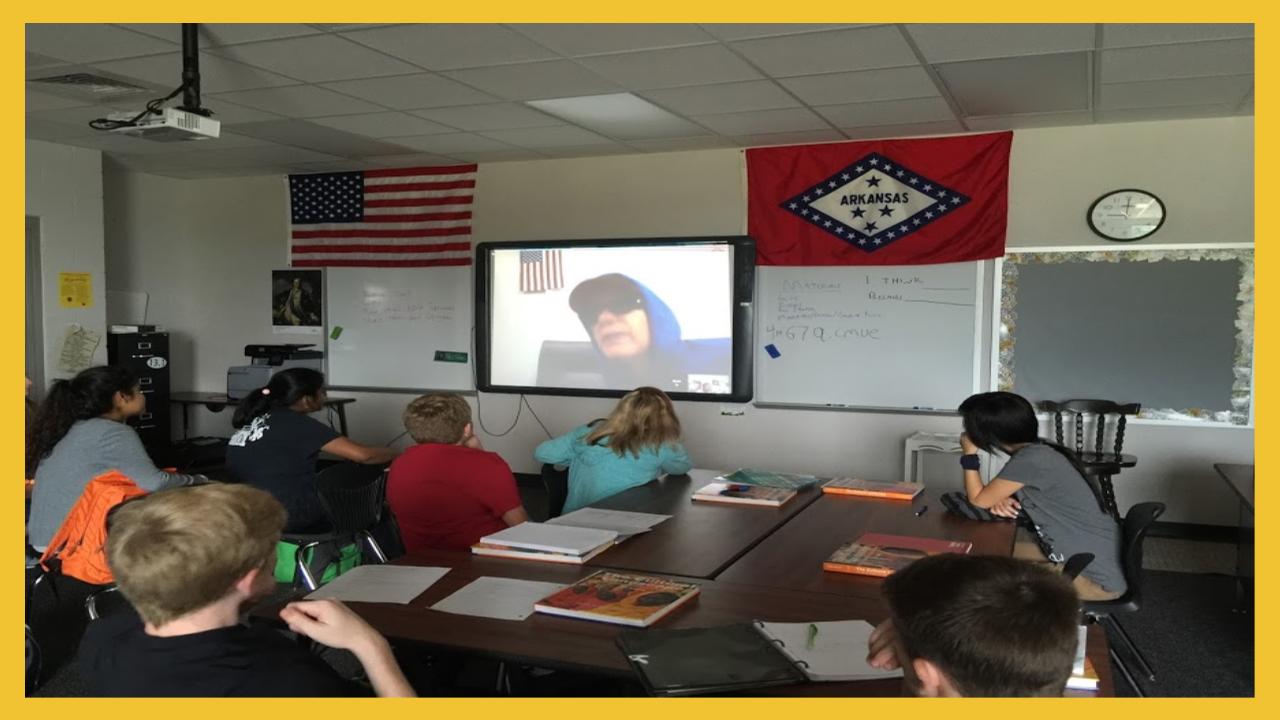 Beyond deeper discussion, it also changed students' view of themselves and their roles in the world. By holding a Hangout once a month with this class throughout the year, Hangouts became a norm of their education, and as a result, students started to view themselves as a part of the global community.
We often hear that as educators we are preparing students for a world with jobs that have not yet been created. Since we know our world is only becoming more connected, it makes sense to build in Hangouts as a norm of our instructional program. Why not use regular Hangouts to prepare our students for their even more connected futures?
Follow me on Twitter: @brian_librarian
Follow the Golden Eagle Library!
On Twitter: @GoldenEagleLMC
On Instagram: Goldeneaglelmc
Contact me by email: bjohnson3@sdale.org
Last year, I held some Mystery Hangouts with classes in the Caribbean, Sweden, Canada and South America for students in the Advanced Placement Geography course at my school. (These Hangouts were also open to all students at Lakeside JHS). They were so popular, that the AP Geography teacher approached me about holding them on a more regular basis this year.
To teach our students Google Hangout etiquette, we decided to try start with a mock Mystery Hangout. I called the class on Hangout from the library while they stayed in their classroom down the hall using my alter ego, Mr. Bond. We employed one of my favorite instructional strategies teaching with nonexamples; in the case of this Mystery Hangout etiquette lesson, what not to do on a Google Hangout.
 For this Hangout, I sketched out a fake class on the whiteboard behind me complete with distracted students. We set it up in the Professional Library area of the library with an American Flag in the background so as not to disguise my location for a Mystery Hangout.
 Throughout the Hangout, I pretended that I could not sit still to reinforce how distracting such behavior is for participants on the other end of the webcam. I also made sure to eat potato chips and drink water while attempting to answer students' questions about my location.

Looking back on the year of Hangouts, the visit with Mr. Bond produced great dividends evidenced by students' participation in our later Hangouts. This was quite a successful year for Mystery Hangouts. We met with classes in South American, Europe (South London), British Columbia and Ontario Canada as well as Transylvania, Romania).
Since students became comfortable in what not to do, they were better prepared to successfully participate. Students were able to apply their learning to speak up, hold still, and ask the right kinds of questions during Hangouts. They were able to develop deeper questions for those who participated in Hangouts with them which in turn, produced higher quality discussions. Being that this is an election year, we had some fascinating discussions after the Mystery portion of the Hangouts with our peers on other continents about their views of American political candidates.
We often hear that as educators we are preparing students for a world with jobs that have not yet been created. Since we know our world is only becoming more connected, it makes sense to build in Hangouts as a norm of our instructional program. Why not use regular Hangouts to prepare our students for their even more connected futures?
Follow me on Twitter: @brian_librarian
Follow the Golden Eagle Library!
On Twitter: @GoldenEagleLMC
On Instagram: Goldeneaglelmc
Contact me by email: bjohnson3@sdale.org
Subscribe to:
Posts (Atom)